



Corporate bonds are one of the capital-raising instruments used by enterprises to supplement funding for business operations, investment or restructuring financial obligations. For Public Companies, Securities Companies and securities investment fund management companies (“Fund Management Company”), private placements of bonds are governed by securities and corporate bond laws, with different conditions and procedures depending on the type of bonds offered and the status of the issuer.
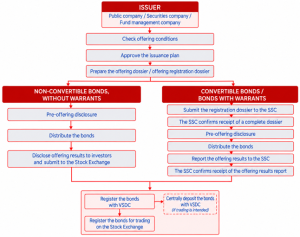
This article focuses on the legal regulations and private placement process for non-convertible bonds without warrants and convertible bonds and warrant bonds issued by Public Companies, Securities Companies and Fund Management Companies in the domestic market. Accordingly, to determine the applicable process, the status of the issuer and the type of bonds proposed to be offered must first be identified. The overall process may be summarized as follows:
- Bond Offering Conditions
1.1. Non-convertible Bonds without Warrants
The law prescribes different conditions for private placements of non-convertible bonds without warrants by Public Companies and by Securities Companies/Fund Management Companies that are not Public Companies. If a Securities Company or Fund Management Company is also a Public Company, the conditions applicable to Public Companies will apply. Accordingly, the offering conditions applicable to each issuer may be summarized and compared as follows:
Criteria | Public Company | Securities Company that is not a Public Company | Fund Management Company that is not a Public Company |
Legal basis | – Article 31.2 of the Securities Law 2019 – Articles 13.1(d) and 16.1 of Decree 200 | – Article 31.4 of the Securities Law 2019 – Articles 13.1(d) and 16.2 of Decree 200 | – Article 31.4 of the Securities Law 2019 – Articles 13.1(d) and 16.2 of Decree 200 |
Conditions on payment of bond principal and interest and due debts | Must have fully paid principal and interest on bonds previously offered or fully paid due debts for 03 consecutive years preceding the offering (if any), except where the offering is made to selected creditors that are financial institutions. | Not applicable | Not applicable |
Financial safety ratio and prudential ratio in operations | Must comply with applicable legal requirements, if any. | Must satisfy financial safety indicators under sector-specific laws; the available capital ratio is determined on the basis of available capital and total risk exposure, and a ratio below 180% triggers the reporting and handling regime prescribed by law[1]. | |
Total liabilities/Equity limit | Total liabilities, including the value of bonds proposed to be issued, must not exceed 05 times Equity. Note: This limit does not apply where the issuer is a state-owned enterprise, an enterprise issuing bonds to implement a real estate project, a credit institution, an insurance enterprise, reinsurance enterprise, insurance brokerage enterprise, Securities Company or Fund Management Company. Such issuers comply with the relevant applicable laws. | The 05-times cap under Decree 200 does not apply. However, a Securities Company remains subject to sector-specific limits[2]: – Total debt/Equity may not exceed 05 times; – Short-term liabilities may not exceed short-term assets. | Not applicable. |
Eligible investors | – Professional securities investors that are organizations; – Professional securities investors that are individuals may participate only if the bonds (i) have a credit rating and are secured by collateral; or (ii) have a credit rating and are backed by a payment guarantee from a credit institution. | ||
Financial statement requirement | The financial statements for the year immediately preceding the issuance year must be audited by an approved audit firm. | ||
1.2. Convertible Bonds and Warrant Bonds
The offering conditions for convertible bonds and warrant bonds apply commonly to Public Companies, Securities Companies and Fund Management Companies. Accordingly, Securities Companies and Fund Management Companies that are not Public Companies must also satisfy the conditions applicable to Public Companies under Article 31.1 of the Securities Law when offering these types of bonds. In addition, Decree 200 prescribes conditions regarding the liabilities/Equity limit and the minimum interval between an offering and certain previous private placements or issuances. The offering conditions are summarized as follows[3]:
Criteria | Convertible Bonds | Warrant Bonds |
Issuer type | The issuer must be a joint stock company | |
Eligible investors | – Strategic investors; – Professional securities investors.
| – Strategic investors; – Professional securities investors that are organizations; – Professional securities investors that are individuals, provided that the bonds (i) have a credit rating and are secured by collateral; or (ii) have a credit rating and are backed by a payment guarantee from a credit institution. |
Foreign ownership limit | The conversion of bonds into shares must comply with the foreign ownership limits. | The exercise of warrants must comply with the foreign ownership limits. |
Total liabilities/Equity limit | For a Public Company that is not a Securities Company or Fund Management Company, total liabilities, including the value of bonds proposed to be issued, must not exceed 05 times Equity. Where the issuer is a Securities Company or Fund Management Company, this limit under Decree 200 does not apply and the issuer complies with the relevant laws as stated in Section 1.1. | |
Offering timing | The offering of convertible bonds and warrant bonds must be at least 06 months after completion of the most recent private placement or issuance falling into one of the following cases: (i) private placement of shares; (ii) private placement of convertible bonds; (iii) private placement of warrant bonds; (iv) private placement of preference shares with warrants; or (v) issuance of shares to swap shares, capital contributions or debt in accordance with law. | |
- Issuance Plan and Offering Dossier
2.1. Issuance Plan
The bond issuance plan of Public Companies, Securities Companies and Fund Management Companies (the “Issuance Plan”) is prepared based on the general contents prescribed in Article 10 of Decree 200. In addition to information on the issuer, bond terms and conditions, payment plan, financial condition and commitments to investors, these issuers should note the following matters when preparing the Issuance Plan[4]:
First, regarding the purpose of the issuance and the plan for use of proceeds. The Issuance Plan must specify the purpose of the issuance, information on the investment project or debt to be restructured, and the plan for use of proceeds by purpose, item, amount and expected disbursement schedule[5]. Where the scheduled disbursement date has not yet arrived, the issuer may temporarily place the proceeds on deposit with a commercial bank or foreign bank branch, or purchase certificates of deposit issued by such institutions, provided that the Issuance Plan clearly sets out the plan for use of such temporarily idle proceeds[6].
Second, regarding the explanation of compliance with the offering conditions. The Issuance Plan must explain compliance with each offering condition under Decree 200 and other relevant laws[7]. As the offering conditions applicable to Public Companies, Securities Companies and Fund Management Companies are not entirely the same, as analyzed in Section 1, the explanation in the Issuance Plan must also be tailored to each type of issuer.
Third, for convertible bonds and warrant bonds. The Issuance Plan must additionally include a plan for conversion of bonds into shares or a plan for exercise of warrants. For convertible bonds, the plan must specify the conditions, period, ratio or method for determining the conversion price, repayment if the bonds are not converted, and a plan to ensure compliance with foreign ownership limits[8]. For warrant bonds, the plan must specify corresponding matters regarding warrant exercise, share issue price and compliance with foreign ownership limits, and must also set out the proposed use of proceeds from the issuance of shares upon exercise of the warrants[9].
Fourth, regarding eligible bond purchasers. The Issuance Plan must clearly identify the bond purchasers appropriate for the type of bonds proposed to be offered and the investor eligibility requirements analyzed in Section 1[10]. Where convertible bonds or warrant bonds are offered to strategic investors, the Issuance Plan must also clearly set out the selection criteria and list of strategic investors[11].
Fifth, regarding financial indicators. The Issuance Plan must present the issuer’s financial indicators for the 03 consecutive years immediately preceding the offering year and any changes after the issuance, including Equity, total liabilities, capital structure, solvency, total outstanding bond borrowings/Equity, profit, profitability, and financial safety indicators and prudential ratios under sector-specific laws[12]. For Securities Companies and Fund Management Companies, this section should reflect the financial safety indicators applicable to securities business organizations; Securities Companies must additionally reflect compliance with the sector-specific limits that total debt/Equity may not exceed 05 times and short-term liabilities may not exceed short-term assets[13].
In addition, the Issuance Plan must present the issuer’s payment of bond interest and principal and other due debts during the 03 consecutive years preceding the offering, reports on the issuance and use of proceeds for outstanding bonds, an assessment of the ability to pay due debts and service the bonds proposed to be issued, and a plan for arranging sources to pay bond interest and principal through maturity[14]. These are particularly important for Public Companies, Securities Companies and Fund Management Companies because information on financial condition, outstanding liabilities and solvency also serves as the basis for demonstrating compliance with the offering conditions set out in Section 1.
2.2. Offering Dossier
Under current regulations, the bond offering dossiers of Public Companies, Securities Companies and Fund Management Companies differ depending on the type of bonds issued. For (i) non-convertible bonds without warrants, the offering dossier must be prepared in accordance with Article 17; and (ii) convertible bonds and warrant bonds, the offering dossier must be prepared in accordance with Article 18 of Decree 200. The key differences in dossier components may be summarized as follows[15]:
Content | Non-convertible Bonds without Warrants | Convertible Bonds/Warrant Bonds |
Documents relating to offering conditions | Must include documents evidencing and undertaking full compliance with the offering conditions under Article 16. | Compliance with the conditions is demonstrated through specific documents in the offering registration dossier under Article 18. |
Decision of the governing body | Must include a decision of the competent authority under law and the issuer’s charter approving the offering dossier and confirming that the dossier is complete, valid, accurate and truthful. | The competent approving bodies are specifically identified as follows: – The GMS approves (i) the Issuance Plan; (ii) investor criteria; and (iii) either itself determines, or authorizes the BOD to determine, the offerees that are professional securities investors and approve the plan to ensure that the issuance of shares upon bond conversion or warrant exercise complies with foreign ownership limits; and – The BOD approves the offering registration dossier and carries out the matters authorized by the GMS above. |
Documents relating to future share issuance | Not applicable. | Must include a plan to ensure compliance with foreign ownership limits upon issuance of shares for conversion and an undertaking not to breach cross-ownership regulations. |
Documents regarding the account for receipt of bond subscription monies | Confirmation of opening an account for receipt of bond subscription monies. | Confirmation of opening an escrow account for receipt of bond subscription monies. Note: The bank at which the account is opened must not be a related person of the issuer. |
- Offering Process and Procedures
When offering non-convertible bonds without warrants, the issuer self-assesses the offering conditions, makes the required information disclosures and distributes the bonds without having to register the offering with the SSC[16]. For convertible bonds or warrant bonds, an issuer that is a Public Company, Securities Company or Fund Management Company must complete the offering registration procedure with the SSC before conducting the offering. The process applicable to the offering of these two groups of bonds by Public Companies, Securities Companies and Fund Management Companies may be summarized and compared as follows:
Offering process and procedures | Non-convertible Bonds without Warrants[17] | Convertible Bonds/Warrant Bonds[18] |
1. Completion of conditions, Issuance Plan and dossier | The issuer self-assesses the offering conditions, approves the Issuance Plan and prepares the offering dossier under Article 17 of Decree 200. | The issuer self-assesses the conditions, approves the Issuance Plan and prepares the offering registration dossier under Article 18 of Decree 200. |
2. Pre-offering procedures with the SSC | Not applicable | The issuer must submit the offering registration dossier to the SSC. Within 07 business days from receipt of a valid dossier, the SSC notifies the issuer that it has received a complete dossier; if the dossier is invalid, the SSC notifies the issuer and states the reasons. |
3. Pre-offering information disclosure | At least 01 business day before the expected commencement date of the offering, the issuer sends the Information Disclosure Statement to subscribing investors and the Stock Exchange; the Stock Exchange subsequently shares the information with the SSC. | After the SSC notifies the issuer that it has received a complete offering registration dossier, the issuer makes the pre-offering information disclosure to subscribing investors and notifies the Stock Exchange. |
4. Provision of dossier to investors | – The issuer provides the offering dossier to investors; – Individual investors must sign a confirmation in the prescribed form. | |
5. Bond distribution | Must be completed within 30 days from the commencement date of the offering. | Must be completed within 30 days from the date of the SSC’s notice acknowledging receipt of a complete dossier. |
6. Management of proceeds during the offering | Bond subscription monies are transferred to the account for receipt of bond subscription monies specified in the offering dossier. | All proceeds must be transferred to an escrow account and may not be used until the SSC notifies the issuer that it has received the offering results report. |
7. Offering results | Within 10 days from the completion date of the offering, the issuer discloses the results to investors and submits a notice of the results to the Stock Exchange. | Within 10 days from the completion date of the offering, the issuer submits the results report, together with the bank’s confirmation of the amount of proceeds received, to the SSC and discloses information on the results. |
8. Completion of post-offering procedures | The Stock Exchange shares the results information with the SSC within 01 business day. | Within 03 business days from receipt of a valid report, the SSC notifies the issuer that it has received the offering results report; only after such notice may the issuer request the release of the escrowed proceeds. |
- Registration, Central Depository and Registration for Trading of Bonds
After completion of the offering, the bonds must be registered with the Vietnam Securities Depository and Clearing Corporation (“VSDC”), centrally deposited before trading or transfer of ownership, and registered for trading on the corporate bond trading system at the Stock Exchange[19]. These obligations generally apply to privately placed corporate bonds; however, the timing for convertible bonds and warrant bonds of Public Companies, Securities Companies and Fund Management Companies is determined based on the SSC’s notice regarding the offering results.
4.1. Registration of Bonds with VSDC
The issuer must register the bonds with VSDC within 05 business days from[20]:
- For convertible bonds and warrant bonds: the date on which the SSC notifies receipt of the offering results report;
- For non-convertible bonds without warrants: the date on which the issuer discloses information on the offering results.
When registering, the issuer must submit the list of bondholders and is responsible for ensuring that the persons named on the list satisfy the eligibility requirements applicable to bond purchasers[21].
Within 05 business days from receipt of a complete and valid dossier, VSDC notifies the issuer that the bonds have been registered and simultaneously sends a notice to the Stock Exchange. Registration with VSDC does not mean that VSDC confirms the legality of the offering or guarantees performance of the issuer’s payment obligations[22].
4.2. Central Depository of Bonds
After registration, the bonds must be centrally deposited with VSDC through a depository member before trading or transfer of ownership[23]. Accordingly, investors open depository accounts with depository members to deposit bonds with VSDC; if an investor already has a securities depository account, the investor may register additional information to use that account for privately placed corporate bonds[24]. A depository member may be a Securities Company or commercial bank that satisfies the relevant conditions and is licensed to conduct securities depository activities under applicable law[25].
Accordingly, bond depository is not an obligation directly performed by the issuer, but is carried out by bondholders through depository members after the issuer has completed the bond distribution and registration with VSDC.
4.3. Registration for Trading at the Stock Exchange
The issuer must register the issued bonds for trading on the corporate bond trading system at the Stock Exchange within 15 business days from[26]:
- For convertible bonds and warrant bonds: the date of the SSC’s written notice acknowledging receipt of the offering results report;
- For non-convertible bonds without warrants: the date on which the issuer discloses information on the offering results.
The issuer submits the application for registration for trading under Article 21.3 of Decree 200 to the Stock Exchange electronically in accordance with the rules of the Stock Exchange[27]. Within 05 business days from receipt of a complete and valid dossier and provided the bonds have been registered with VSDC, the Stock Exchange notifies the issuer that the bonds have been registered for trading and discloses the information on the corporate bond information portal. If the registration is rejected, the Stock Exchange must notify the issuer and state the reasons[28]. Within 10 business days from the date of the Stock Exchange’s notice that the bonds have been registered for trading, the issuer must put the bonds into trading on the system[29].
- Exercise of Bondholders’ Rights
After the bonds are put into trading, the issuer remains responsible for fully performing its obligations to bondholders in accordance with the terms and conditions of the bonds and the Issuance Plan. Specifically, the issuer must pay bond principal and interest in full and on time and perform any attached rights; where mandatory early redemption is required, the issuer must carry out the redemption in accordance with applicable regulations[30].
For convertible bonds and warrant bonds, the issuer must convert the bonds into shares or issue shares upon exercise of warrants in accordance with the conditions, time limits and approved Issuance Plan, and must also fulfill the related information disclosure obligations[31].
Throughout the period in which the bonds remain outstanding, the issuer must also maintain periodic and extraordinary information disclosure obligations, including information on principal and interest payments, use of proceeds, performance of commitments to bondholders and events affecting the issuer’s solvency[32].
———-
[1] Pursuant to Articles 4, 6 and 11 through 16 and Appendix VI of Consolidated Document No. 47/VBHN-BTC dated 26 December 2025 of the Ministry of Finance consolidating Circular No. 91/2020/TT-BTC dated 13 November 2020 and Circular No. 102/2025/TT-BTC dated 29 October 2025 on financial safety indicators and measures for handling securities business organizations that fail to satisfy financial safety indicators (“Consolidated Document 47”).
[2] Article 26 of Consolidated Document No. 09/VBHN-BTC dated 17 April 2026 of the Ministry of Finance consolidating the Circular regulating operations of securities companies (“Consolidated Document 09”).
[3] Article 31.1 of Securities Law No. 54/2019/QH14 dated 26 November 2019 of the National Assembly, as amended and supplemented from time to time (“Securities Law”), and Article 16.3 of Decree No. 200/2026/ND-CP dated 05 June 2026 of the Government regulating private placement and trading of corporate bonds in the domestic market and offering of corporate bonds in the international market (“Decree 200”).
[4] Article 10.1 of Decree 200.
[5] Articles 10.1(b) and 10.1(c) of Decree 200.
[6] Article 10.1(c) of Decree 200.
[7] Article 10.1(d) of Decree 200.
[8] Article 10.1(e) of Decree 200.
[9] Articles 10.1(g) and 10.1(h) of Decree 200.
[10] Article 10.1(r) of Decree 200.
[11] Article 10.1(r) of Decree 200.
[12] Article 10.1(l) of Decree 200.
[13] Article 92 of the Securities Law and Article 26 of Consolidated Document 09.
[14] Article 10 of Decree 200.
[15] Articles 17 and 18 of Decree 200.
[16] Articles 15 and 17.2 of Decree 200.
[17] Article 17.2 of Decree 200.
[18] Article 19 of Decree 200.
[19] Articles 20 and 21 of Decree 200.
[20] Articles 20.1(a) and 20.1(b) of Decree 200.
[21] Article 20.1(c) of Decree 200.
[22] Articles 20.2 and 20.5 of Decree 200.
[23] Article 20.4 of Decree 200.
[24] Article 7.1 of Circular No. 30/2023/TT-BTC dated 17 May 2023 of the Minister of Finance guiding registration, depository, exercise of rights, transfer of ownership, transaction settlement and organization of the trading market for privately placed corporate bonds in the domestic market.
[25] Article 56.1(a) of the Securities Law 2019.
[26] Articles 21.1 and 21.2 of Decree 200.
[27] Articles 21.4(a), 21.4(b) and 21.4(c) of Decree 200.
[28] Articles 21.4(a), 21.4(b) and 21.4(c) of Decree 200.
[29] Article 21.4(d) of Decree 200.
[30] Articles 7.1(c), 7.1(đ), 12 and 22 of Decree 200.
[31] Articles 10.1(e), 10.1(g) and 33.1 of Decree 200.
[32] Articles 31 and 32 of Decree 200.
————
Disclaimer: This article has been prepared by PTN Legal LLC (“PTN Legal”) for the sole purpose of providing reference information to readers. PTN Legal makes no representation or warranty as to the accuracy or completeness of this information. The contents of this article may be changed, amended, or updated without prior notice. PTN Legal assumes no responsibility for any errors or omissions in this article, or for any damage arising from the use of this article in any circumstances. Please visit PTN Legal’s website to view our previous articles here.
Readers who wish to receive articles from PTN Legal by email may register their information here.
This article was prepared by Thao Vu, Paralegal.