


With increasingly improved infrastructure and more open legal policies, in the context of a volatile international environment, Vietnam has become an attractive investment destination for many foreign enterprises. It is witnessed that numerous multinational corporations have chosen to establish enterprises and set up manufacturing facilities in Vietnam, demonstrating a long-term commitment to their operations. Typically, foreign enterprises prioritize establishing production facilities within industrial zones due to the advantages of complete, synchronized infrastructure and professional support services.
However, prior to implementing business investment activities in industrial zones, foreign investors (the “FI” or “FIs“) must clearly understand the procedures and necessary permits to establish and officially commence business operations in Vietnam. The following article provides an overview of the aforementioned issues based on updated provisions of Law on investment No. 143/2025/QH15 passed by the National Assembly on 11 December 2025 (“Law on Investment 2025“), Law on Construction No. 135/2025/QH15 passed by the National Assembly on 10 December 2025 (“Law on Construction 2025“), and Decree No. 96/2026/ND-CP guiding the implementation of the Law on Investment 2025 promulgated by the Government on 31 March 2025 (“Decree 96“) to provide FIs with additional information before implementation.
In general, the implementation of a foreign-invested project in an industrial zone involves the main steps illustrated in the following diagram:
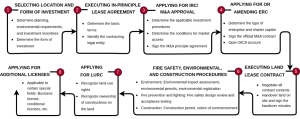
- Selecting investment location and investment form
Selecting an investment location is the first critical step when an FI plans to conduct business in Vietnam. A suitable investment location can determine the efficiency and potential success of the subsequent establishment and business operations. In practice, FIs may seek information regarding investment locations by (i) searching for information on the official web portals of industrial zone developers and investment registration authorities, (ii) contacting local investment promotion centers directly, or (iii) contacting the management boards of the industrial zones where they intend to establish operations.
Note that, in addition to considering the commercial criteria targeted by the FI, such as land rental rates, service fees, facilities, transport infrastructure, and connectivity to consumption markets and raw material sources, ect., the FI must also verify the following factors:
- The consistency of the proposed business operations with the industrial zone planning. In practice, each industrial zone has its own industry-specific planning orientation; for example, some industrial zones permit textile and garment manufacturing, some permit metal plating or battery production, while others may prohibit or allow such activities only under certain restrictions.
- Environmental limits and requirements, particularly for industries with a high risk of causing environmental pollution. Environmental protection requirements may include plans, technologies, and facilities for the treatment of wastewater, waste, and emissions that foreign investors must satisfy prior to the official operation of production facilities;
- Investment incentives available to foreign investors when conducting business in Vietnam. Under the regulations, subjects eligible for investment incentives include (i) investment projects in sectors eligible for investment incentives, (ii) investment projects in geographical areas eligible for investment incentives, and (iii) large-scale investment projects with high labor usage.[1] Forms of investment incentives include (i) corporate income tax incentives, (ii) exemption from or reduction of land use fees, land rental, or land use tax, and (iii) import duty exemptions for goods imported to create fixed assets, and raw materials, supplies, and components imported for production in accordance with the laws on export and import duties.[2]
Regarding the forms of investment, foreign investors may basically consider the following two forms:
- Establishing an economic organization wholly owned by the foreign investor. Through this method, the foreign investor shall have full discretion over all matters related to the establishment of the company, the organizational structure, personnel apparatus, business plans, and the creation of the company’s assets (including factories); or
- Purchasing shares or capital contributions in an existing company in Vietnam operating in the sector targeted by the foreign investor. Through this method, the foreign investor can utilize existing resources owned by the target company, such as factories, licenses, suppliers, customers, and employees. However, the foreign investor must also simultaneously consider the ownership ratio, the ability to control and make decisions, and the outstanding debt obligations of the target company. This requires the foreign investor to conduct thorough legal and financial due diligence on the target company.
Each form of investment will correspond to different licensing procedures as presented below.
- Executing in-principle agreement for the lease of an investment location
After selecting an investment location, based on the investment form of establishing an economic organization, foreign investors may consider the following options to establish the right to use the investment location: (i) leasing land from an industrial park developer and constructing the factory/production facility themselves, or (ii) leasing land and an existing factory from a third party.
Regardless of the chosen option, foreign investors usually must execute an in-principle agreement/memorandum of understanding with the lessor (which may be the industrial park developer or a party leasing land from the industrial park developer) regarding the lease/sublease of land and factories within the industrial park (the “In-Principle Agreement“). In addition to serving as a deposit to reserve the location, the In-Principle Agreement is a required document in application dossier for Investment Registration Certificate (“IRC”), as stipulated in Decree 96.[3]
Regarding the parties to the Principle Agreement, since the economic organization owned by the Foreign Investor (the “Project Company“) has not yet been established, the Foreign Investor will typically execute this agreement and perform the deposit and payment of initial costs in accordance with the terms of the Principle Agreement. Pursuant to the regulations, legitimate expenses incurred during the investment preparation stage prior to the issuance of the Investment Registration Certificate by the competent authority may be paid by the Foreign Investor via offshore remittance or from the Foreign Investor’s foreign currency or Vietnamese Dong payment accounts opened at authorized banks in Vietnam.[4] After the Investment Registration Certificate is issued by the competent authority, these funds may be (i) converted in part or in full into the Foreign Investor’s capital contribution to the Project Company, (ii) converted in part or in full into a foreign loan of the Project Company, subject to compliance with regulations on foreign loan registration, or (iii) refunded to the Foreign Investor after deducting legitimate expenses related to investment preparation activities in Vietnam.[5]
- Applying for IRC / M&A Approval to implement the Project
- If the Foreign Investor chooses the option of establishing a Project Company, the Foreign Investor must carry out the procedures to apply for an IRC at the Industrial Park Management Board or the Department of Finance in the locality where the Foreign Investor intends to implement the investment project or establish an operating office to implement the investment project.[6] According to the Decree 96, the investment registration authority shall issue the IRC within 10 working days from the date of receipt of a valid application file, provided the project meets the following conditions[7]:
- The project is not in a sector or trade prohibited from investment and business;
- An investment project location is secured, based on supporting documents such as land use rights documents, site lease agreements, or other instruments and documents identifying the location for implementing the investment project;
- The project is consistent with the relevant master plans;
- The project satisfies market access conditions and technology use conditions for projects subject to technology appraisal (if any).
Note that for certain specific or sensitive projects that have socio-economic, security, or environmental impacts as prescribed by law, which are implemented within an industrial park and are consistent with the industrial park’s master plan, the Foreign Investor must obtain investment policy approval from the Industrial Park Management Board prior to applying for the IRC.[8]
- If a foreign investor chooses to purchase shares or equity interests in a target company operating in Vietnam which (a) results in the foreign investor holding more than 50% of the charter capital of the target company or (b) involves a target company operating in business lines subject to conditions for foreign investors, the foreign investor must carry out procedures to register the capital contribution or purchase of shares or equity interests in the economic organization (“M&A Approval”).[9] Accordingly, the relevant parties (the foreign investor and the transferring shareholders/members in the case of a transfer of shares or equity interests, or the foreign investor and the target company in the case of a capital contribution/purchase of newly issued shares of the target company) must sign an agreement in principle regarding the capital contribution or purchase of shares or equity interests. This contract will be submitted to the licensing authority along with other documents in the M&A Approval application file. In practice, for convenience and simplicity, the parties will submit a short-form contract to carry out the licensing procedures. Within 15 working days from the date of receipt of a valid application, the investment registration authority will review and issue the M&A Approval. After obtaining the M&A Approval, the parties will sign the formal contract and proceed with the procedures to register the change in charter capital and the change of shareholders/members with the business registration authority (if required).
- Applying for an Enterprise Registration Certificate (“ERC”) to establish the Project Company/amend the ERC
After being granted the IRC, the foreign investor must proceed with the procedures to apply for an ERC to establish the Project Company in Vietnam. This procedure is typically quite simple and does not require the submission of many dossiers or documents. According to the regulations, the issuance of the ERC shall be carried out within 03 working days from the date the licensing authority receives a valid application.[10]
Prior to establishing the enterprise, the foreign investor should also consider the following issues:
- Type of enterprise to be established: Under Vietnamese law, a foreign investor may consider establishing a company in the following forms: (a) a single-member limited liability company, (b) a limited liability company with two or more members, or (c) a joint-stock company;
- Charter capital of the Project Company: According to the regulations, the foreign investor must contribute the full amount of the registered charter capital into the Project Company within 90 days from the date of issuance of the ERC. In principle, the capital contribution by the foreign investor into the Project Company must be made through a direct investment capital account (“DICA”).[11] Therefore, the Project Company needs to proceed with the procedures to open a DICA after being granted the ERC to receive the capital contribution from the foreign investor.
If a foreign investor chooses to purchase shares or stakes in a target company, the parties must carry out procedures to amend the Certificate of Business Registration to reflect the change in members of the limited liability company or the change in charter capital (if any), and update the internal documents of the company, such as the register of shareholders, to record the status of the foreign investor as a member or shareholder. The rights and obligations of the foreign investor as a member or shareholder of the economic organization are established upon completion of the procedures for changing members or shareholders. The transfer of capital contributions or payment for the purchase of shares or stakes by the foreign investor in this case must also be conducted through a DICA after obtaining M&A Approval.[12]
- Executing the official lease contract for the investment location
After the Project Company is established, the Project Company and the lessor (the industrial park developer or the sub-lessor of land from the industrial park developer) may sign a official land lease or infrastructure lease contract, whereby the lessor will hand over the land to the Project Company for the construction of the factory (in the event the Project Company chooses to construct its own production facility) or hand over the workshop (in the event the Project Company chooses to sub-lease a workshop). The parties should prepare a handover memorandum to determine the actual status of the land and workshop (if any) at the time of handover to avoid future disputes.
- Implementating environmental, fire prevention and fighting, and construction procedures
After completing the procedures for the establishment of the Project Company, the Project Company must typically carry out the following procedures to be permitted to construct the factory and officially commence operations:
- Environmental procedures: Depending on the scale, capacity, nature, and environmental impact of the production industry that the foreign investor intends to implement, and in accordance with the laws on environmental protection, the Project Company may be required to carry out one of the following environmental procedures: (a) preparation and submission for approval of an environmental impact assessment report; (b) application for an environmental permit; or (c) environmental registration.
- Fire prevention and fighting procedures: Depending on the floor area of the construction work and in accordance with the laws on fire prevention and fighting, the Project Company may be required to carry out the following procedures: (a) preparation and submission for approval of the fire prevention and fighting design appraisal; and (b) preparation and submission for the fire prevention and fighting acceptance inspection.
- Procedures for applying for a Construction Permit: Except for certain cases of exemption under the Law on Constructions[13], the Project Company must apply for a construction permit to be authorized to construct the works. In the event of an exemption from a construction permit, the Project Company is still required to perform the procedure of notifying the commencement of construction, whereby the Project Company must send a notice of commencement together with a dossier corresponding to the application dossier for a construction permit as prescribed (excluding the Application for a construction permit) to the competent state management agency for construction in the locality where the works are constructed, as decentralized by the provincial people’s committee.[14]
- Applying for the Certificate of land use rights and ownership of assets attached to land (“LURC”)
Under the regulations, a Project Company leasing land or sub-leasing land within an industrial park shall be issued a Certificate of Land Use Rights and shall have the rights and obligations corresponding to each form of land lease (land lease with a one-off rental payment for the entire lease term or land lease with annual rental payments). This Certificate of Land Use Rights is a document issued by the competent state authority to record the land use rights as well as the ownership of works constructed on the land by the Project Company. In the event that the Project Company needs to mobilize capital from credit institutions, this is also an important document required by such credit institutions. The processing time for the application for the issuance of a Certificate of Land Use Rights is typically approximately 30 working days from the date of submission of a valid application dossier.
- Applying for additional licenses to conduct business in certain specialized sectors
Foreign investors should note that under Vietnamese law, certain specialized sectors will require additional licenses, in addition to the primary licenses mentioned above, in order to conduct business activities in Vietnam, including:
- A Business License in the event that the Project Company engages in wholesale or retail distribution, excluding goods such as rice, sugar, video recordings, books, newspapers, magazines, or the provision of logistics services.
- A License to establish a retail outlet in the event that the Project Company establishes a retail establishment;
- A Certificate of satisfaction of food safety and hygiene conditions for beverage production and food processing sectors;
- A Certificate of eligibility for pharmacy business for the production of drugs and medicinal materials;
- A Certificate of eligibility for cosmetic production for the cosmetic manufacturing sector;
- A License for the retail or wholesale of alcohol in the case of alcohol trading….
Notable new points of the Law on Investment 2025 that foreign investors should consider when investing in projects in Vietnam in the near future:
- According to the provisions of the Law on Investment 2025, foreign investors may establish an economic organization to implement an investment project prior to performing the procedures for the issuance of an IRC.[15] After establishment, the economic organization implementing the investment project shall perform investment procedures in accordance with the law on investment. Accordingly, market access conditions for foreign investors, including the ratio of charter capital ownership, investment sectors, scope of investment activities, etc., will be considered during the procedures for establishing the economic organization.[16] Furthermore, according to the Decree 96, within 12 months from the date of establishment of the Project Company, the Project Company must complete the procedures for the issuance of the IRC.[17]
- The Law on Investment 2025 has introduced a new provision regarding “special investment procedures” applicable to investment projects in industrial parks, export processing zones, high-tech zones, concentrated digital technology zones, free trade zones, international financial centers, and functional zones within economic zones, except for projects implementing in economic zones, free-trade zones and project involving infrastructure construction of industrial parks, export processing zones, and centralized information technology zones that must obtain investment policy approval as prescribed by the Government and.[18] Accordingly, if foreign investors opt for these special investment procedures, they shall be exempt from procedures for preparing environmental impact assessment reports, formulating detailed planning, applying for construction permits, and other procedures for approval or consent in the fields of construction and fire prevention and fighting. In such cases, the investment registration dossier shall require to include an additional undertaking to satisfy the conditions, standards, and technical regulations prescribed for construction, environmental protection, and fire prevention and fighting; the investment project proposal shall include the identification and forecasting of environmental impacts and measures to mitigate adverse environmental impacts in lieu of the environmental impact assessment dossier.[19]
[1] Article 14.1 Law on Investment 2025.
[2] Article 14.2 Law on Investment 2025.
[3] Article 39.1 and Article 32.1 Decree 96.
[4] Article 8 Circular 06/2019/TT-NHNN issued by the State Bank of Vietnam on 26 June 2019, providing guidance on foreign exchange control for foreign direct investment activities in Vietnam, as amended from time to time (“Circular 06”).
[5] Article 8 Circular 06.
[6] Article 27 Law on Investment 2025.
[7] Article 39.3 Decree 96.
[8] Article 25.4 Law on Investment 2025.
[9] Article 21 Law on Investment 2025.
[10] Article 26.5 Law on Enterprises No. 59/2020/QH14 issued by the National Assembly on 17 June 2020, as amended and supplemented by Law No. 76/2025/QH15 issued by the National Assembly on 17 June 2025.
[11] Article 5 and Article 6 Circular 06.
[12] Article 5 and Article 6 Circular 06.
[13] Article 43 Law on Construction 2025.
[14] Article 43.3 Law on Construction 2025.
[15] Article 19.2 Law on Investment 2025.
[16] Article 19.2 Law on Investment 2025.
[17] Article 72.2 Decree 96.
[18] Article 46 Decree 96.
[19] Article 47 Decree 96.
Disclaimer: This article is prepared by PTN Legal LLC (“PTN Legal”) solely for the purpose of providing reference information to readers. PTN Legal does not commit to or guarantee the accuracy or completeness of this information. The content of the article may be amended, adjusted, or updated without prior notice. PTN Legal shall not be liable for any errors or omissions in this article or for any damages arising from its use in any circumstances.